The complementary role of different recycling technologies
This article explores why different recycling technologies—chemical, advanced mechanical, and basic—are all needed to manage the diversity of plastic waste. It explains the strengths and trade-offs of each approach, how they address different environmental and economic priorities, and why all of them play a critical role in building effective, scalable, and locally appropriate circular systems.


Stakeholders across the plastics and plastic waste system remain divided over the role and effectiveness of different recycling technologies, particularly chemical recycling. Some view chemical recycling as a primary solution, while others argue it should be deployed only as a last resort.
The Alliance takes a technology-agnostic position. It seeks the best available solution for a given problem, independent of specific technologies or commercial interests. Crucially, the Alliance does not view any single recycling technology as a universal solution. Plastic waste streams are diverse, and effective management requires multiple technologies deployed in complementary ways.
A necessary starting point is clarity on the problems recycling is intended to address. Stakeholders prioritise different objectives, which leads to different views on appropriate solutions. These priorities typically fall into four broad categories:
- Better use of natural resources: reducing plastic use, increasing recycling rates, lowering reliance on fossil feedstocks, improving consumer awareness, and advancing a “circular economy for plastics”.
- Reduction of plastic pollution: preventing litter and environmental leakage, reducing landfill use, and lowering risks to human health and biodiversity.
- Lower cost of waste management: capturing economic value from waste, creating employment, and reducing economic and political dependence on fossil fuels.
- Mitigating climate impact: “de-fossilising” production, reducing emissions from virgin plastic manufacturing, and limiting reliance on incineration.
The relative importance of these objectives varies across organisations, countries, and contexts. Views also differ on the role of recycling relative to other circular strategies, such as reduction, reuse, refill, substitution with renewable feedstocks, and compostable or biodegradable materials. These differences, combined with inherent uncertainties, drive wide variation in stakeholder positions.
The Alliance consolidates these considerations into three evaluation lenses for assessing waste management and recycling solutions.
Eliminating plastic leakage and poor waste management
Plastic leakage into natural environments harms marine and terrestrial ecosystems, threatens biodiversity, and creates long-term environmental liabilities for future generations. This problem is most acute where basic waste management systems are underdeveloped in terms of regulations and household waste management infrastructure. As systems mature, recycling becomes an increasingly important component of effective waste management. It enables value recovery, offsets system costs, and offers better environmental outcomes than landfill or incineration.
Lowest carbon intensity
Climate change presents systemic risks, and waste management solutions vary significantly in their carbon impact. Plastics often have lower CO2e intensity than alternative materials due to reduced material use, lighter weight, and better product protection, particularly for food packaging. However, plastic production still accounts for approximately 3 percent of global greenhouse gas emissions and could reach around 13 percent of the 2050 1.5°C carbon budget.
Circular solutions, including recycling, offer opportunities to reduce these emissions. Different recycling technologies involve distinct trade-offs between energy use, carbon intensity, and cost.
Waste management decisions must also be considered holistically. Incineration of plastics is generally undesirable, but incineration can reduce methane emissions from biodegradable waste such as paper, food, and garden waste that would otherwise be landfilled. Methane has a very high global warming potential. Without very effective biogas capture, incineration is preferable to landfill and the energy required for incineration can be partially supplied by plastic waste, reducing the need for additional fossil fuels. Using plastic as a source of energy is however a wasted opportunity to further reduce carbon emissions through recycling and so such should be considered as a transitional measure.
Cost and practicality
Improving waste management and reducing carbon emissions carries a net cost. Net cost reflects the balance between value captured, such as the sale of recyclates, and capital and operating expenses, accounting for risk, returns, and financing costs. Lower net cost reduces societal burden and accelerates investment and adoption.
However, the lowest-cost option is not always the most environmentally beneficial. High-quality, closed-loop recycling typically involves higher capital and operating costs than basic recycling into low-value applications. In many cases, the value of the recyclate alone is insufficient to justify the investment, making policy support necessary to improve economic viability.
These tensions can be managed over time. Early system design may prioritise lower-cost solutions using existing infrastructure. As policies, technologies, and systems mature, emphasis can shift toward solutions that deliver higher environmental performance.
Recycling technologies
Three broad recycling technology categories are considered, each with distinct roles, costs, and benefits.
- Chemical recycling includes pyrolysis, hydrothermolysis, depolymerisation, and gasification. These processes can handle mixed plastic streams, within limits, to produce polymers identical to virgin material, as well as other chemical and fuel outputs.
- Advanced mechanical recycling, including dissolution or physical recycling, relies on advanced washing, decontamination, melt filtration, pelletisation, and homogenisation. It requires highly homogeneous feedstocks and produces high-quality recyclates capable of displacing virgin polymers.
- Basic mechanical recycling uses more mixed waste streams to produce lower-value plastic products and construction materials, such as plastic lumber, roofing tiles, and cement or asphalt substitutes.
Comparisons between technologies are highly context-dependent. Nonetheless, several general observations can be made as the table below:
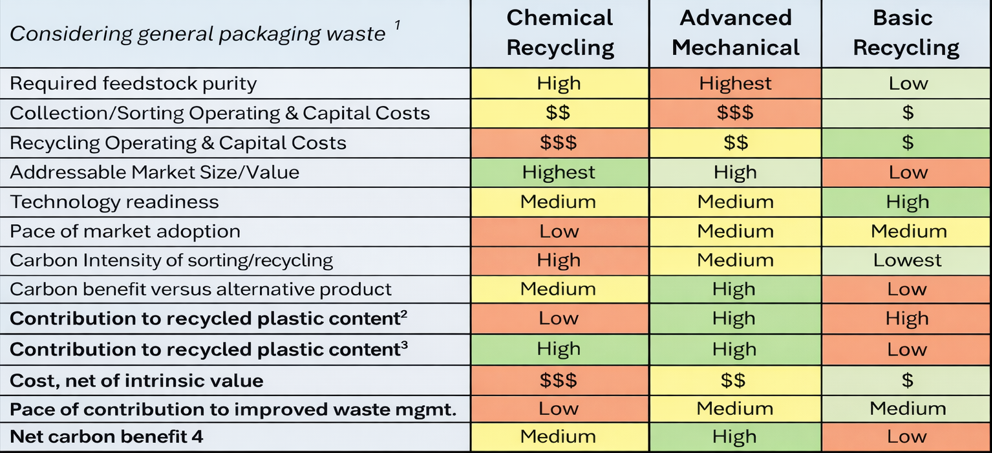
2/3. With/without mass balance attribution for chemical recycling.
4. Comparison versus disposal in landfill.
From this table, it is clear there is no single “winning” solution.
Chemical recycling, particularly when combined with mass balance attribution, enables the highest levels of closed-loop recycling and recycled content in high-value applications. This is especially important for regulated uses such as food-contact and medical applications, as well as specialty polymers that are difficult to reach through mechanical processes. Chemical recycling can also process complex materials, including multi-layer and multi-material films.
At the same time, chemical recycling typically has the highest net cost and the lowest net carbon benefit. Economic performance depends on feedstocks with high polyolefin content and limited contaminants such as halides, oxygenates, and heavy metals. Large-scale deployment will take time, reflecting both technological maturation and implementation complexity. It should also be noted that newer generations of chemical recycling technologies are expected to reduce costs, improve yields, and reduce carbon intensity compared to first-generation commercial plants, reducing the gaps to other technologies.
Advanced mechanical recycling offers greater net carbon benefit than chemical recycling due to lower energy requirements and higher material yields that directly displace virgin polymers. Existing recycling facilities can often be upgraded, enabling faster deployment than chemical recycling. However, advanced mechanical recycling requires highly homogeneous feedstocks, either through segregated collection or intensive sorting. Food-contact approval remains a significant constraint, particularly under European regulatory frameworks, with PET being a notable exception and some emerging solutions under development.
Advanced mechanical recycling involves higher logistics, sorting, and processing costs than commonly assumed. Therse costs narrow the perceived gap between advanced mechanical and chemical recycling.
Repeated mechanical recycling degrades polymer chains over time, reducing material performance and limiting the number of recycling cycles. While additives and processing innovations can extend usability, degradation is ultimately unavoidable. At that point, materials must either be downcycled into lower-value applications through basic recycling or upcycled through chemical recycling to restore polymer quality. The Alliance refers to this progression as cascade recycling; maintaining the highest possible value for as long as feasible while accepting gradual value loss over multiple cycles.
Basic recycling has the lowest capital and technical barriers to entry and is less dependent on policy support. It plays an essential role in managing complex materials and residual streams that cannot be processed through advanced or chemical routes. However, it contributes the least to plastic-to-plastic circularity and delivers lower carbon benefits and end-market value.
No single technology satisfies all objectives. Chemical recycling enables high-quality closed-loop applications but at higher cost and lower carbon benefit. Advanced mechanical recycling delivers strong environmental performance but depends on highly controlled feedstocks. Basic recycling offers accessibility and resilience but limited circularity. All three are therefore required simultaneously within an effective circular system, with deployment shaped by regional policy priorities, infrastructure maturity, and historical practices.
Product design guidelines also influence technology choice and system performance. While plastic packaging must meet demanding functional requirements, simplification is often possible. Examples include avoiding unnecessary colouring and inks, reducing multi-material structures, and harmonising polymer choices across similar applications. Design improvements can increase value capture and expand viable recycling pathways.
Market mapping
Market mapping is used to align waste stream components with end-market applications and identify optimal solution pathways. It assesses:
- quality requirements and value of target applications
- cost and feasibility of suitable recycling technologies
- cost and viability of the collection and sorting systems needed to provide feedstock for the recycling operation.
Although often visualised through Sankey diagrams like the one below, the primary value of market mapping lies in the shared understanding it creates among stakeholders. It clarifies constraints, priorities, and trade-offs across consumer behaviour, collection systems, infrastructure, policy, and financing. These can inform a road-map for system evolution from near-term possible to longer-term ideal.
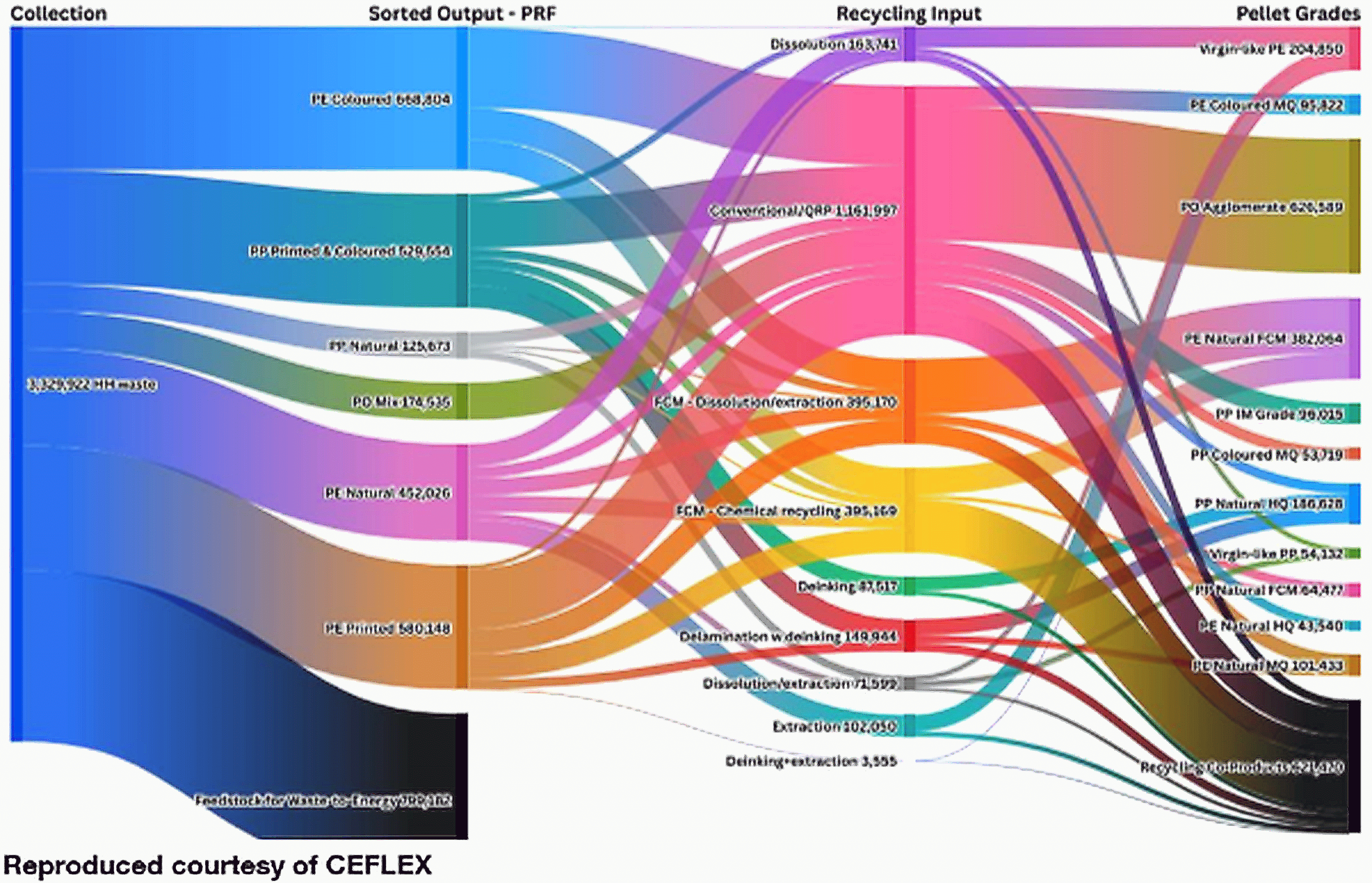
Market mapping typically seeks to employ advanced mechanical recycling as much as possible due to its lower net cost and higher carbon benefit. However, advanced mechanical recycling cannot address the most demanding and/or regulated end-uses, nor multi-material laminates or streams that are not well sorted. Chemical recycling is then the best fit solution.
Summary
No recycling technology is inherently superior across all contexts. Optimal choices depend on the specific problem being addressed, market complexity, infrastructure maturity, and economic conditions. In the absence of strong policy drivers such as recycled content mandates, widely-accepted design guidelines or eco-modulated EPR, basic recycling is often the most economically viable option.
It is not possible to predict a universal capacity split across technologies. All play a role. In mature systems, an illustrative balance might be 40 percent chemical recycling, 40 percent advanced mechanical recycling, and 20 percent basic recycling. In emerging systems, the balance may shift toward basic recycling. Market mapping provides the basis for defining an appropriate pathway in each context.
Globally, existing recycling capacity across all technologies remains well below what is required. Any economically viable investment in recycling infrastructure is unlikely to be regretted. The greater risk lies in delaying decisions and investment, as the precise role of each technology will continue to evolve with experience, policy development, and technological progress.
Related
.jpg)
Stay in the loop
Subscribe to our newsletter for the latest news and updates from the Alliance