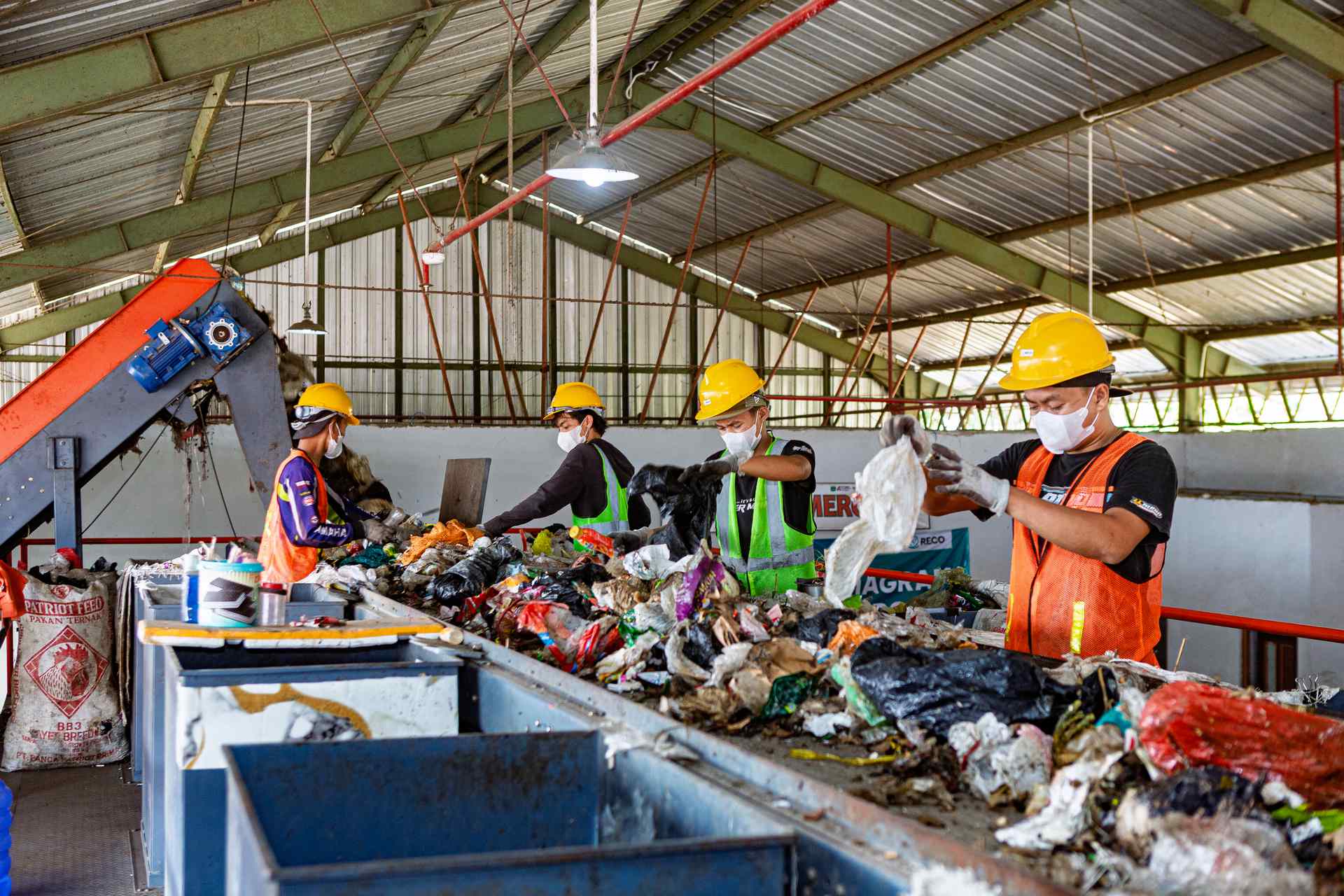
From capital to circularity: Mobilising investment to advance plastics circularity
Transitioning to a circular economy for plastics will require an estimated US$1.2 trillion in investment. The Alliance works with partners to co-develop financing mechanisms that help de-risk projects, reduce the cost of capital, and strengthen project pipelines.


An estimated 11 million tonnes of plastic enter the ocean each year, a figure that could rise to 29 million tonnes by 2040 without significant action. Solutions exist across the value chain, from reducing plastic waste at source to improving collection and recycling. Transitioning to a circular economy for plastics will require an estimated US$1.2 trillion in investment1.
Yet, mobilising capital remains a significant challenge. While innovative technologies and business models continue to emerge across the waste management and recycling value chain, many promising solutions struggle to access financing and move beyond pilot projects or early commercial stages.
The challenge is particularly acute in emerging and developing economies, where waste management infrastructure remains underdeveloped and investment needs are greatest. Addressing this requires not only access to capital, but also projects with credible pathways to commercial viability.
The Alliance to End Plastic Waste works with partners to address these challenges by co-developing financing mechanisms and contributing technical expertise, concessional capital, and grant funding. This helps de-risk projects, reduce the cost of capital, and strengthen project pipelines.
Financing solutions to mobilise investment
We work with financial institutions, investment managers, development finance institutions (DFIs), governments, and other partners to develop financing approaches that respond to different investment needs across the waste management and recycling value chain. Each offers a different way to address financing gaps, manage risk, and attract capital from a broader range of investors.
Blended finance
The Green Investments Partnership (GIP) illustrates how blended finance can bring together different sources of capital to support sustainable infrastructure and transition projects. Established under Singapore’s Financing Asia’s Transition Partnership (FAST-P) initiative and managed by Pentagreen Capital, GIP is a blended finance debt vehicle supporting projects across South and Southeast Asia.
The Alliance participates through a junior interest position while also providing technical expertise in assessing recycling technologies. At its second close, GIP increased its committed capital from US$510 million to US$800 million.
Private-sector investment
The Alliance also works with investment managers and other partners to develop private-sector financing solutions for businesses and infrastructure critical to plastics circularity.
The Alliance co-designed and seeded the Plastic Circularity Strategy with Lombard Odier Investment Managers. The fund deploys growth equity into companies developing solutions in areas including plastic waste sorting and recycling. The Alliance also provides technical advisory support. The fund recently reached its final close.
Partnerships with development finance institutions
Collaboration with DFIs provides another route to mobilising capital for waste management infrastructure.
The Alliance is the first private-sector contributor to the Asian Infrastructure Investment Bank (AIIB)’s Project-Specific Window financing facility, helping to unlock approximately US$150 million in sovereign lending to Indonesia to strengthen integrated solid waste management services across more than 10 cities and districts, including investment in waste management infrastructure and institutional capacity.
Making projects investable
Mobilising capital is essential, but financing alone cannot ensure that investments succeed. The Alliance’s experience highlights the importance of strengthening project pipelines, improving commercial viability, and addressing gaps across the wider system.
Projects need credible pathways towards financial sustainability, supported by appropriate technical capabilities and operating models. Investors also need confidence in the prospects of the businesses and infrastructure they finance, including how projects will generate revenue and manage risk over time.
Demand for recycled materials is another important consideration. Reliable end-markets and clearer demand signals can strengthen the commercial case for investment in collection, sorting, and recycling infrastructure. Multi-year offtake agreements, for example, can provide greater certainty around future revenues.
Policy frameworks also influence investment prospects. Effective implementation of extended producer responsibility schemes and other enabling policies can help support demand for recycled materials and improve the commercial conditions for collection, sorting, and recycling systems.
These factors extend beyond financing alone and often require coordinated action across industry, finance, and government. The Alliance works with partners to address barriers within its remit, strengthen project pipelines, and support the development of solutions that can attract investment.
Working across the system to advance plastics circularity
Building a circular economy for plastics requires investment across the entire system, from waste collection and sorting to recycling infrastructure and end-markets.
Financing mechanisms can help mobilise the necessary capital, but projects also need credible commercial propositions and the wider conditions to operate sustainably.
The Alliance brings together financing approaches, technical expertise, and strategic partnerships to address these challenges. By working with stakeholders across the public and private sectors, we aim to help close gaps that prevent capital from flowing to the projects and systems needed to advance plastics circularity.
The objective is not simply to mobilise more capital, but to help direct investment towards solutions that can work in practice and contribute to a circular economy for plastics.
-----------
1 Global Plastic Action Partnership (2022) Unlocking the plastics circular economy: Case studies on investment. World Economic Forum. Available at: https://www.thecirculateinitiative.org/wp-content/uploads/Unlocking-the-Plastics-Circular-Economy_Case-Studies-on-Investment_Dec_2022.pdf (Accessed: 26 October 2026).
Related
Stay in the loop
Subscribe to our newsletter for the latest news and updates from the Alliance